
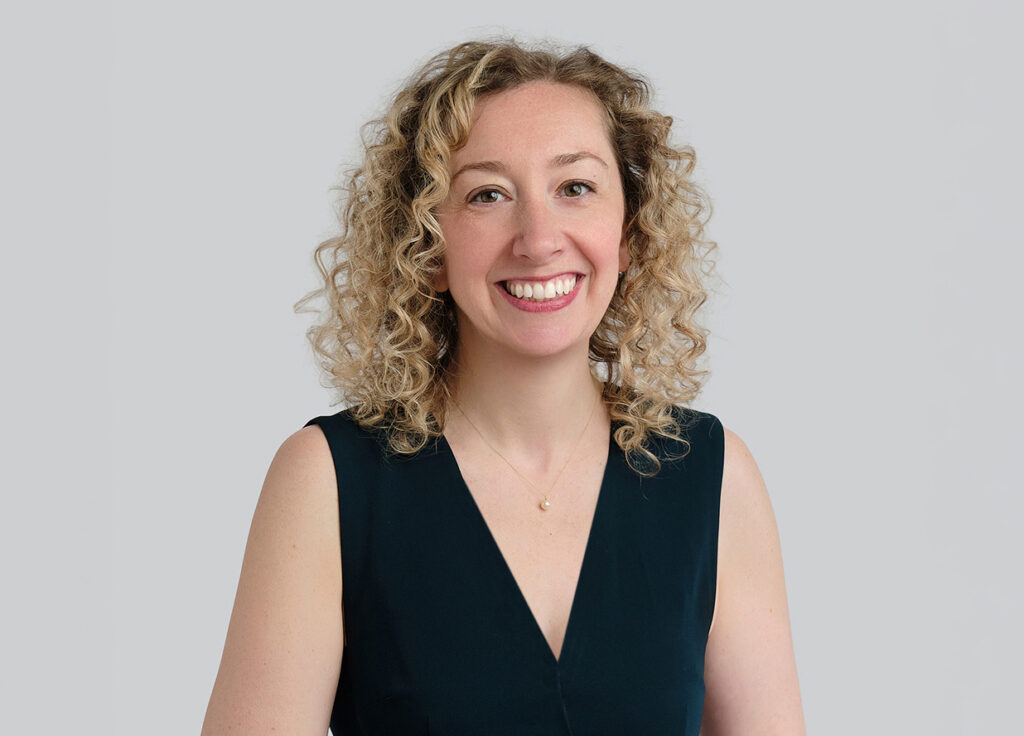
This August, Boston Children’s Museum welcomed Melissa Higgins as the ninth President in the Museum’s 113-year history. Melissa has been with the Museum since 2018, when she joined as Senior Director for STEAM Programming. In 2021, she was named Vice President of Programs & Exhibits.
Melissa graduated from Connecticut College with a B.A. in architecture, but a summer internship at Boston’s Museum of Science changed her career trajectory. She worked at the Museum of Science for more than a decade, creating engineering resources for kids in elementary school classrooms. She later worked in public media, spending time at the WGBH Education Department to lead their strategic planning and development.
It was during her time at WGBH that a friend sent her the posting for an opening here at Boston Children’s Museum. Though she was happy in her role at GBH, Melissa says she thought to herself at the time “If I don’t apply to this, I will regret it.”
Since that moment, Melissa has made enormous contributions to the Museum, leading the expansion of the Museum’s STEAM programs and public programming, helping to shape new initiatives and secure major grants, and establishing strategic corporate partnerships.
Now, as she takes over for President Emerita Carole Charnow, Melissa is aware of the enviable position she’s been left in by her predecessor. Of Carole, Melissa says, “I feel very lucky to have worked with her for 8 years, and I have a hard time imagining the Museum could be in a better position than we are at this moment.” But she’s also cognizant of the incredible history of the Museum itself. Her vision for the Museum is one that builds on that history, and on the legacy of innovation, sustainability, and financial independence built by Carole.
Describing her vision for the Museum, Melissa says, “It’s hard to be in this building and look at the work that has been done over that long, long history and not feel that sense of a legacy of breaking new ground and creating things from where there was nothing. I read everything I can get my hands on about the history of this place and the history of children’s museums. Not because I think we should go backwards, but because I think some of the work that’s been done in the past really gives us clues about what we should be doing going forward. Especially at this institution, there has always been a real focus on innovation and creating brand new things. Experimentation is key to our history.”
The future of the Museum, Melissa says, is connected to the families it serves, and the communities to which it connects: “It can be difficult to find spaces where families can be together, create lasting memories, and have that very special experience. Boston Children’s Museum is one of the few places in the city where families can come and be almost guaranteed to not just build a memory for that week, but a lifetime memory. It’s incredible that this space can help facilitate that.”
She believes the Museum can do even more memory-making by being intentional in how we reach out to families — especially those who historically have had difficulty accessing the Museum. Being intentional about community engagement, exhibit design, and curriculum planning, Melissa says, is how the Museum ensures that all families know they are welcome within our walls, and how we continue to expand access to communities beyond Boston.
Melissa also believes that, as the second oldest children’s museum in the country, Boston Children’s Museum has a responsibility as a leading institution to innovate, experiment, and share lessons learned from both successes and failures with other museums across the country. We’re lucky, she says, to be in a position where we can try new things, and share what we learn with other museums that may not have the same room to experiment.
Above everything else, the Museum will continue to serve the children who have always been at the center of our mission. As Melissa says, “Our child audience, many under the age of six, is at a really important time for laying the foundation for who they’re going to be later in life. The opportunity to support caregivers with children of that age and to support the kids themselves is truly unique. I just feel very lucky that we get to do that here.”